
A prehistory museum tour with a Paleolithic archaeologist
Five stops and five group questions in the prehistory hall of the National Museum of Iran, led by an archaeologist who has spent years bringing stone tools out of the ground.
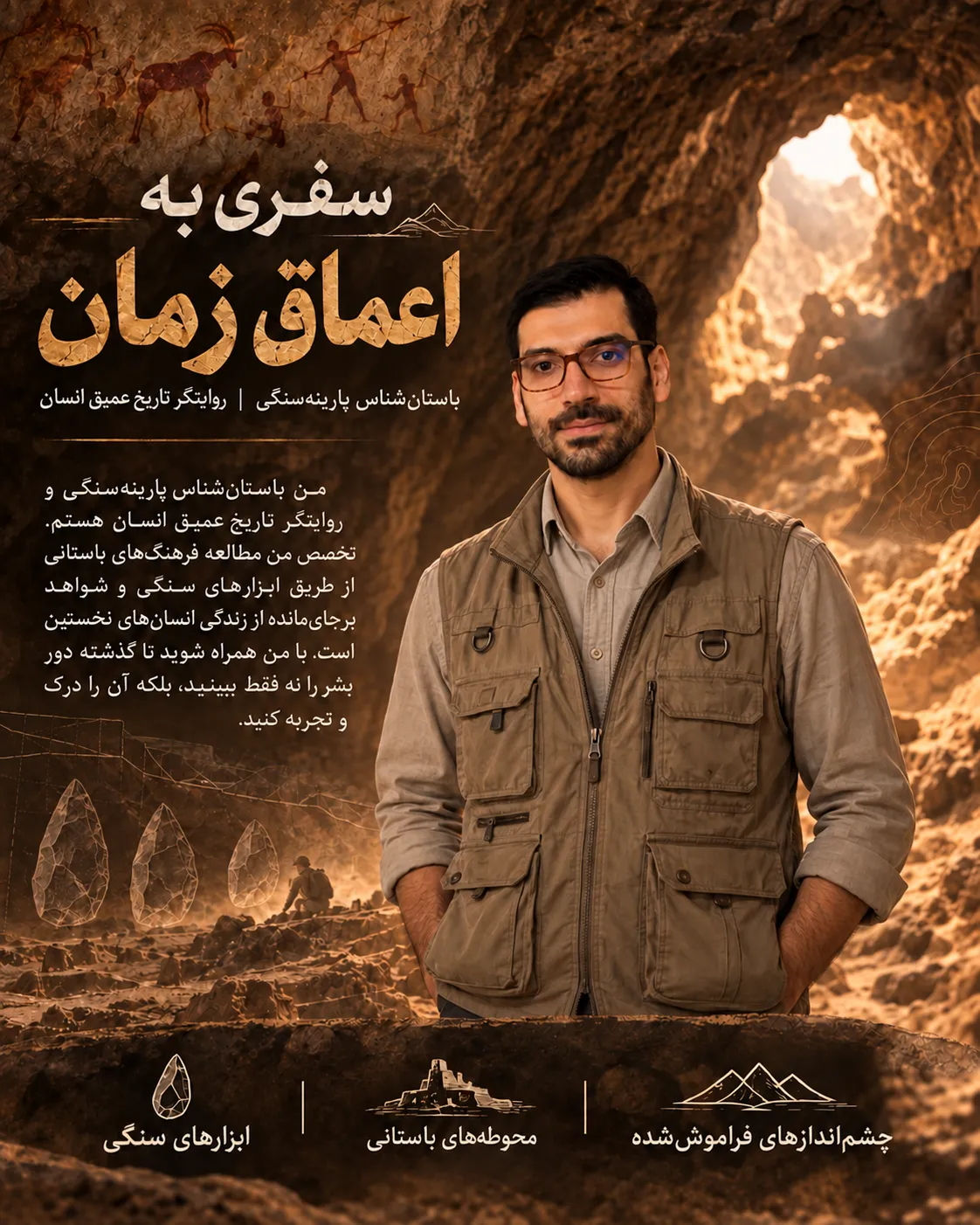
دکتر میلاد هاشمی
Paleolithic archaeologist
I search for the traces of the earliest humans, where a few pieces of stone tools reveal signs of the technology, thinking and life story of humans tens and hundreds of thousands of years ago! Come with me on a journey into the Paleolithic world!
About this experience
Most visitors hurry past the display cases of stone tools: a few gray pebbles that all seem alike. On this visit, those very cases are where we begin. Dr. Milad Hashemi, a Paleolithic archaeologist and faculty member at Tarbiat Modares University who has co-directed the excavation of Qaleh Kurd Cave with Dr. Hamed Vahdati Nasab since 1397 (2018/19), leads the group from the oldest part of the hall to the first villages. The route has five stops. At each one you hear a few minutes of storytelling, and then small groups work through a question: for example, which of several tools was made for butchering, or, judging by the shape of the edges, what kind of blows its maker used to reach that form. Dr. Hashemi checks the answers himself, right beside the case. There are no notes to memorize; everything moves forward through questions and answers. A simple comparison helps you feel the scale: Persepolis is about 2,600 years old, yet the dating margin of error for the youngest layer of Qaleh Kurd Cave is ten thousand years on its own. At the end there's an open question circle: ask anything about chronology, Neanderthals, or how an archaeologist can tell that a stone is a tool. Every participant receives a shareable experience certificate. Meeting point: the entrance of the National Museum of Iran, 30 Tir Street. The museum's Ancient Iran building is being rearranged; dates will be announced right here after final coordination with the museum. Photos of the prehistory hall are from the National Museum of Iran's account on Wikimedia Commons (CC BY-SA 4.0).
This page has been translated. The languages your host speaks are listed under Details.
What's included
Museum entry ticket Dr. Milad Hashemi's storytelling and company along the entire route Group question cards Shareable experience certificate
What to bring
Comfortable shoes; you'll be on your feet for about two and a half hours If you like, a small notebook for notes
Frequently asked questions
How is this different from a regular museum tour?
On a regular tour, the guide usually explains and you listen. Here, at every stop you have a group question and reach the answer yourselves. The stories also come from first-hand excavation experience, not from a guidebook.
Is it suitable for children?
Ages 10 and up. The questions are designed so that teenagers can solve them right alongside the adults.
Do we get to touch the objects?
The museum's objects are behind glass. If you'd like to hold a stone tool and make one yourself, that's exactly what the “A day in the Stone Age” experience is for.
When will the dates be announced?
The National Museum's Ancient Iran building is being rearranged. Dates will be posted right here after coordination with the museum.
What if I have a specialist question?
That's what the closing question circle is for. Dr. Hashemi welcomes hard, well-considered questions.
Details
- Age group
- All ages
- Host language
- Persian
- Location
- موزهی ملی ایران، خیابان سی تیر، تهران
Where we'll meet
موزهی ملی ایران، خیابان سی تیر، تهران